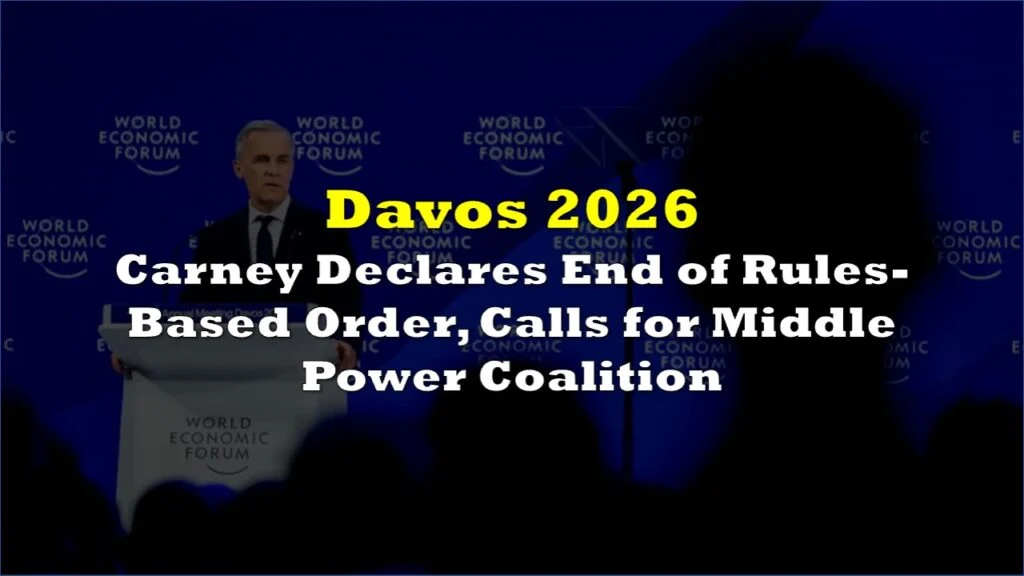
Introduction: A Watershed Moment in Davos
On January 22, 2026, at the annual meeting of the World Economic Forum in Davos, Canadian Prime Minister Mark Carney delivered a speech that is already being described as one of the most consequential addresses by a Western leader in decades. In a departure from the cautious language typically heard in multilateral forums, Carney declared that the “rules-based international order” — the framework that has underpinned global stability since the end of World War II — is no longer functioning as advertised.
Rather than offering incremental reforms, Carney called for a strategic reassessment of how middle powers operate in a world increasingly shaped by great power rivalry. His remarks immediately drew analysis from publications such as Foreign Policy, Financial Times, and policy institutions including the Carnegie Endowment for International Peace.
The Core Message: Stop Pretending the Old Order Still Works
Carney’s central thesis was blunt: policymakers must stop invoking the “rules-based international order” as if it still meaningfully constrains major powers. According to reporting and analysis in Foreign Policy, Carney argued that the term has become a diplomatic reflex rather than a reflection of reality.
For decades, the post–World War II system — anchored in institutions such as the United Nations, the World Trade Organization, and NATO — was built on shared norms: respect for sovereignty, open markets, and collective security. But Carney suggested that this framework has eroded under the pressure of geopolitical competition, selective enforcement of rules, and rising economic nationalism.
Instead of pretending that universal rules are equally applied, Carney urged leaders to recognize that we are operating in an era defined by power politics and strategic competition.
Economic Integration as a Weapon
One of the most striking elements of Carney’s speech was his focus on the weaponization of economic interdependence.
As highlighted in analysis by the Financial Times, Carney pointed to how major powers increasingly use tariffs, export controls, financial sanctions, and supply chain leverage as instruments of coercion. Economic integration — once seen as a pathway to peace — has become a domain of strategic contest.
He emphasized three critical vulnerabilities:
-
Tariffs and Trade Barriers – Used not merely for domestic protection, but as geopolitical leverage.
-
Financial Infrastructure – Control over global payment systems and reserve currencies can be deployed as strategic tools.
-
Supply Chains – Concentrated production in critical sectors (energy, semiconductors, food) creates exploitable dependencies.
Carney’s warning was clear: middle powers cannot assume that global markets are politically neutral.
“If You’re Not at the Table, You’re on the Menu”
Perhaps the most quoted line from the speech was:
“If you are not at the table, you are on the menu.”
This phrase encapsulated his argument that countries like Canada, Australia, Japan, South Korea, and many European states must coordinate more closely. According to analysis from the Carnegie Endowment for International Peace, the speech could mark a turning point in how middle powers conceptualize their collective influence.
Rather than aligning reflexively with one superpower bloc or another, Carney proposed structured cooperation among middle powers to shape trade standards, technology norms, and security frameworks. This approach would not replace alliances but would add a new layer of strategic coordination.
Strategic Autonomy: Feeding, Fueling, and Defending the Nation
Another powerful moment came when Carney declared:
“A country that cannot feed itself, fuel itself, or defend itself has few options.”
This statement underscored the concept of strategic autonomy — the idea that nations must maintain core capabilities in food production, energy security, and defense.
Data from NATO shows that defense spending among member states has increased significantly in recent years, reflecting growing awareness of geopolitical risk. Carney’s remarks suggest Canada may further recalibrate its defense and industrial strategy in light of global instability.
Strategic autonomy does not mean isolationism. Instead, it implies resilience: diversified trade partners, domestic industrial capacity in critical sectors, and credible defense capabilities.
The Trump Context and US-Canada Relations
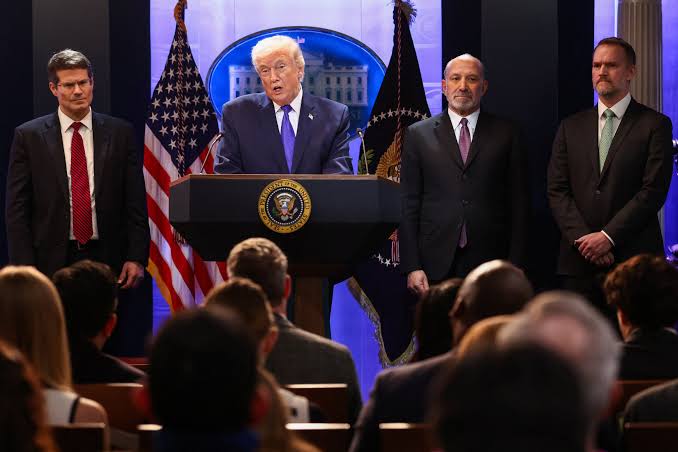
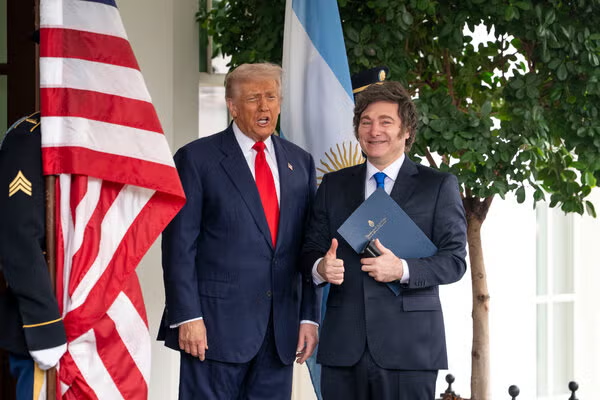
Although Carney did not mention U.S. President Donald Trump by name, multiple analyses — including coverage from Reuters — interpreted the speech as a pointed critique of U.S. policy under the second Trump administration.
Key tensions reportedly include:
-
Tariff disputes affecting Canadian exports
-
Trade renegotiations
-
Signals of American retrenchment from multilateral commitments
The speech reflects a broader concern among middle powers that traditional alliances may no longer guarantee predictability. For Canada, whose economy is deeply integrated with the United States, the implications are especially significant.
Implications for Global Governance
Carney’s remarks raise profound questions about the future of multilateralism. Institutions that once provided stability are increasingly strained by great power competition.
Policy institutions such as the Council on Foreign Relations and the Brookings Institution have published extensive analysis on the evolving balance between global cooperation and strategic rivalry. The debate centers on whether multilateral institutions can adapt — or whether new coalitions will emerge to fill governance gaps.
Carney’s proposal implicitly supports the latter: flexible coalitions of middle powers that can coordinate policies without waiting for consensus among superpowers.
Canada’s Evolving Foreign Policy Doctrine
Historically, Canada has positioned itself as a bridge-builder — active in peacekeeping, trade liberalization, and climate diplomacy. Carney’s speech suggests a shift from bridge-building to coalition-building.
For ongoing policy updates and official statements, Canada’s foreign affairs strategy can be followed through Global Affairs Canada.
The long-term question is whether Canada’s approach will inspire similar strategic recalibrations in other middle powers.
Conclusion: A Defining Transition Moment
Mark Carney’s Davos 2026 speech may ultimately be remembered as a defining acknowledgment that the post–World War II order has entered a new phase. Rather than mourning the erosion of the old system, Carney urged leaders to confront reality and adapt.
His message was not fatalistic — it was pragmatic. The rules-based order may no longer function as once imagined, but middle powers still have agency. Through strategic autonomy, coordinated alliances, and resilience in critical sectors, they can shape the next phase of global governance.
Whether history views this speech as the beginning of a new middle-power era or simply a reflection of deepening great power rivalry remains to be seen. But one thing is certain: Davos 2026 will not be remembered as business as usual.